
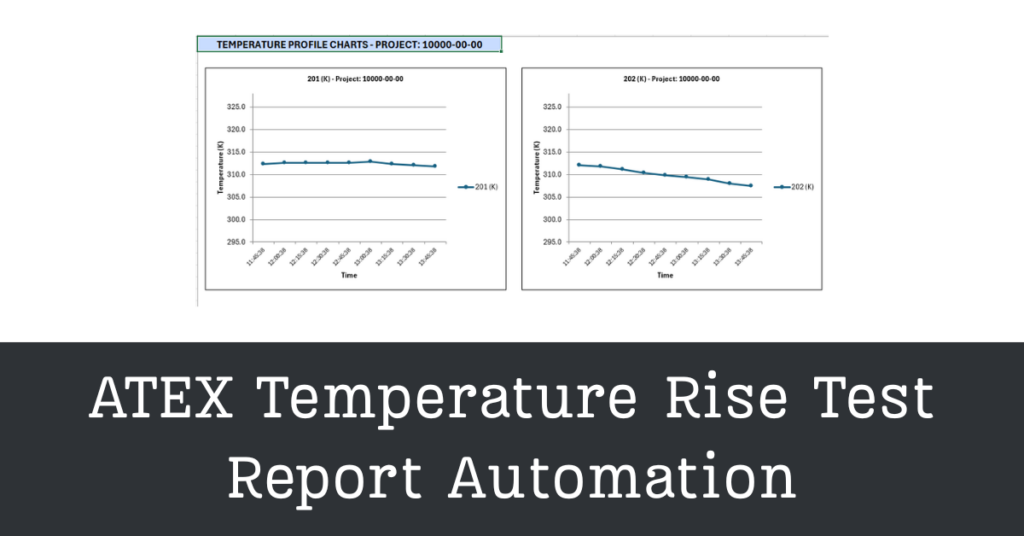
An Excel VBA automation system that reduced ATEX certification temperature rise report generation from 2-3 hours to 10 minutes, enabling increased testing capacity without additional overhead.
CHALLENGE
Control panel manufacturers seeking ATEX or IECEx certification for electrical equipment in hazardous locations must conduct rigorous temperature rise testing. The testing protocol requires monitoring 10+ thermocouples for several hours until thermal equilibrium is reached, generating many temperature readings.
The traditional post-test workflow would involve manual CSV data cleaning (handling UTF-16 encoding issues, removing metadata rows, standardizing formats), calculating statistical analysis across all measurement points, generating individual temperature profile charts for each location, and formatting comprehensive certification reports for submission to notified bodies.
This manual process would consume 2-3 hours of engineering time per test. With our company conducting approximately 20 tests annually and anticipating growth in ATEX work, this overhead represented a significant bottleneck in certification timelines and workforce capacity.
SOLUTION
Developed a macro-enabled Excel workbook that automates the entire post-test data processing and report generation workflow.
The system consists of two primary automation routines accessible via simple button clicks:
The data cleaning macro addresses the incompatibility between Agilent BenchLink Data Logger’s UTF-16 CSV export format and Excel’s UTF-8 expectations, strips metadata header rows while preserving column structure, standardizes time formatting, and outputs a cleaned CSV ready for analysis.
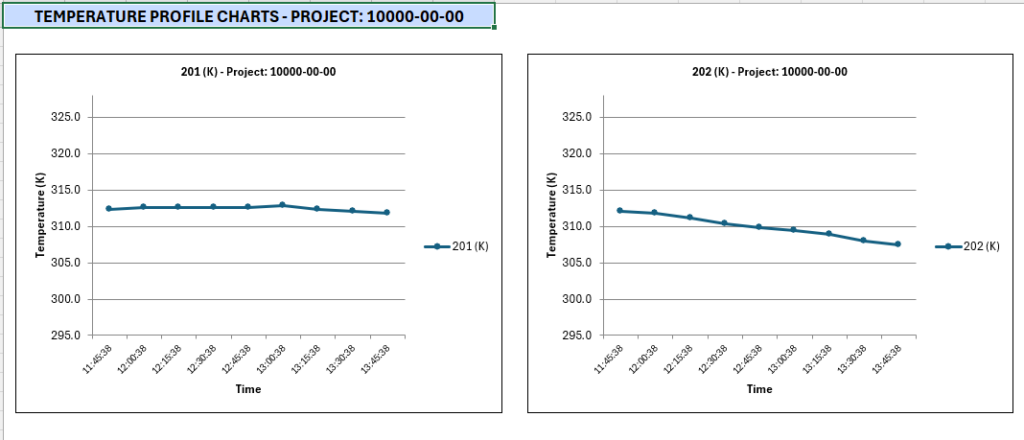
The report generation macro processes the cleaned data to calculate comprehensive statistics (min, max, range, average, standard deviation) for each temperature channel plus global values, generates individual line charts for all measurement locations with consistent formatting, applies intelligent conditional formatting to highlight critical values, and produces a print-ready certification report with all required elements.
Key Technologies: Excel VBA, Data Processing Automation, Statistical Analysis, Automated Visualization, Compliance Documentation
OUTCOME
Reduced post-test processing time from 2-3 hours to approximately 10 minutes (85-90% reduction in manual effort). For the anticipated 20 temperature rise tests per year, this represents 40-50 hours of recovered engineering time annually, with capacity to scale as ATEX work grows without adding overhead.
The automation eliminated arithmetic errors and formatting inconsistencies inherent in manual report generation, ensuring every report follows the same template and statistical methodology.
Professional, comprehensive reports can now be created immediately after test completion, enabling same-day submission to certification bodies and shortening overall certification timelines by days or weeks.
– TECHNICAL OVERVIEW –
Understanding the ATEX/IECEx Testing Requirement
ATEX (European) and IECEx (International) standards mandate comprehensive temperature rise testing for electrical equipment intended for use in potentially explosive atmospheres. The testing verifies that equipment surface temperatures and internal component temperatures remain within safe limits specified by temperature class ratings (T1 through T6), preventing potential ignition sources.
Testing Protocol Requirements:
- Multiple measurement points: 10+ thermocouples at critical locations (terminals, surfaces, internal components, transformers, overload relays)
- Extended duration: Several hours of continuous monitoring until thermal equilibrium is reached
- Statistical rigor: Documentation of maximum temperatures, ranges, stability verification, and calibration traceability
- Comprehensive reporting: Formal documentation including test conditions, complete temperature profiles, statistical analysis, and qualified personnel sign-off
For control panel manufacturers, this testing represents a critical path item in the certification process. Delays in report generation directly extend time-to-market for certified products.
The Manual Workflow Problem
Before automation, the post-test workflow using the Keysight 34970A Data Acquisition Unit with Agilent BenchLink Data Logger 3 software would have involved numerous manual steps:
- Export raw data from BenchLink software (produces UTF-16 CSV with metadata headers)
- Manually convert file encoding to UTF-8 for Excel compatibility
- Clean header rows and format inconsistencies
- Calculate min/max values for each measurement channel
- Compute statistical summaries across all sensors
- Generate individual temperature profile charts (10+ charts per test)
- Format tables and apply highlighting to critical values
- Assemble the final certification report with proper structure and sign-off sections
- Print or convert to PDF for submission
Bottlenecks:
- File encoding issues caused Excel import failures
- Manual chart generation was tedious and error-prone
- Statistical calculations required careful cell referencing to avoid errors
The Solution: Two-Stage Workflow
Stage 1: Data Cleaning Automation
A cleaning macro solves the fundamental compatibility problem between the data logger’s output format and Excel’s requirements:
Key Functions:
- Encoding Conversion: Automatically handles UTF-16 to UTF-8 conversion that previously required manual intervention
- Header Management: Strips the first four metadata lines from BenchLink output while preserving column headers (Scan, Time, Elapsed, channel names)
- Time Standardization: Parses raw timestamp formats and applies consistent HH:MM:SS formatting
- Output Management: Saves cleaned data as “cleaned_data.csv” in the same directory as the source file
Result: One-click transformation from raw logger output to analysis-ready dataset.
Stage 2: Report Generation
The report generation macro transforms cleaned data into a complete, print-ready certification document:
Intelligent Data Analysis:
- Automatically processes all temperature channels (handles variable channel counts)
- Calculates comprehensive statistics: min, max, range, average, standard deviation per channel
- Computes global statistics across all measurement points
- Analyzes timestamps to calculate total test duration and sampling interval
Automated Visualization:
- Generates individual line charts for each temperature channel
- Applies common Y-axis scaling for comparative analysis
- Uses professional formatting (colors, fonts, gridlines) automatically
- Embeds charts directly in the report at appropriate locations
Professional Formatting:
- Includes project header with user-specified project number
- Organizes data into structured tables (global statistics, per-channel analysis)
- Applies conditional formatting
- Adds verification sign-off section for qualified personnel signature
- Configures print layout, headers, footers, and margins automatically
Result: Direct printing to PDF for certification body submission without additional formatting.
Measurable Business Impact
Time Savings:
- Before: 2-3 hours per test for manual processing
- After: ~10 minutes per test with automation
- Savings: ~2.5 hours per test average = 85-90% reduction
Potential Annual Impact:
- 20 tests/year × 2.5 hours saved = 50 hours/year recovered
- Labor cost savings: 50 hours × average engineering rate = significant ROI
Scalability:
- System handles increased ATEX work volume without adding processing overhead
- If testing volume doubles to 40 tests/year, time savings scale proportionally to 100 hours/year
- Enables business growth in ATEX certification services without hiring additional processing staff
Quality Improvements:
- Consistency: Every report follows identical structure, statistical methodology, and formatting standards
- Accuracy: Automated calculations eliminate transcription errors and formula mistakes
- Professionalism: Certification bodies receive polished, comprehensive documentation that accelerates their review process
Certification Cycle Time:
- Same-day report generation enables immediate submission to notified bodies
- Faster turnaround can shorten overall certification timelines by days or weeks
- Particularly valuable during design iterations where multiple test cycles are required
Future Enhancement Potential
While the current system delivers substantial value, several enhancements could further improve the workflow:
Pass/Fail Assessment:
Adding automatic temperature class limit checks (T1-T6) would enable automatic compliance verification with clear pass/fail indication in the report, eliminating the manual comparison step.
Database Integration:
Archiving test results in a centralized database would enable trend analysis across projects, statistical process control for panel assembly quality, and rapid retrieval of historical certification data.
Multi-Project Batch Processing:
Extending the macro to process multiple test files in a single run would be valuable for labs conducting high volumes of testing or for processing backlogged tests after equipment upgrades.
Broader Application: The “Last Mile” Automation Opportunity
This temperature rise testing solution represents a pattern common across industrial testing and quality control environments:
The Pattern:
- Sophisticated instrumentation generates excellent raw data
- Manual post-processing creates bottlenecks between data collection and actionable reporting
- Excel VBA occupies the sweet spot: powerful enough for complex calculations and formatting, plus accessible to engineers without programming backgrounds
Other Applications: This same approach applies to any repetitive test protocol producing CSV or ASCII output:
- Vibration qualification testing (IEC 60068-2-6)
- IP rating verification
- Dielectric strength testing
- EMC/EMI measurements
- Material testing (tensile strength, hardness, composition)
- Environmental chamber data (temperature cycling, humidity exposure)
In each case, the workflow is similar: collect data with precision instruments, automate the formatting and statistical analysis, generate professional reports that meet regulatory or customer requirements.