
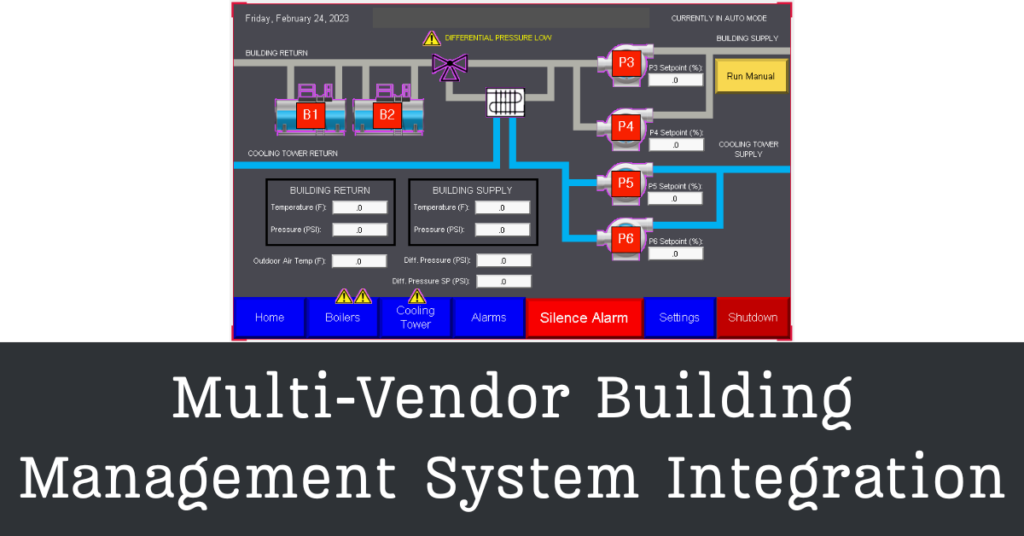
A centralized building management system integrating heating, cooling, and circulation equipment from multiple vendors into a cohesive, operator-friendly control platform for a multi-story residential facility.
CHALLENGE
Building management systems represent one of the most challenging integration environments in industrial automation. Commercial HVAC systems involve heating specialists, cooling tower designers, valve manufacturers, instrumentation providers, and facility managers, each with their own protocols, interfaces, and operational priorities.
This multi-story residential facility required coordinated heating, cooling, and circulation systems operating 24/7 with minimal maintenance intervention. The path to reliable climate control meant integrating equipment from multiple vendors into a cohesive system where a boiler system provided dry contact alarms and expected discrete enable signals, a cooling tower required analog speed references and discrete valve signals, and instrumentation vendors supplied sensors with varying output signals requiring scaling into meaningful engineering units.
SOLUTION
Implemented an Allen Bradley Micro850 PLC as the central coordination controller, receiving signals from all equipment and executing unified control logic.
The PLC integrated analog inputs from temperature and pressure transmitters, discrete inputs from boiler alarms, pump faults, and valve positions, and coordinated control across subsystems through intelligent sequencing.
A PV800 HMI provided multi-screen visualization including main overview with color-coded status, dedicated equipment screens for boiler and cooling tower, password-protected settings for maintenance adjustments, and unified alarm management consolidating faults from all subsystems.
The system implements dual-mode operation: automatic mode with PID control loops maintaining setpoints and seasonal logic, and manual mode allowing operator-specified speeds while the PLC continues monitoring safety interlocks.
Key Technologies: Allen Bradley Micro850 PLC, PV800 HMI, System Integration, PID Control, Sequential Logic, Alarm Management
OUTCOME
Successfully delivered a unified building management system that coordinates heating, cooling, circulation, and instrumentation from multiple vendors into a single, operator-friendly interface.
The system has operated reliably, for over 2 years now, with zero maintenance calls related to control programming, demonstrating the robustness of the centralized coordination logic and comprehensive alarm management.
The PV800 HMI provides facility operators with complete visibility into system status across all equipment, while password-protected settings enable maintenance adjustments without requiring PLC programming tools.
The centralized control architecture allows operators to manage the complex multi-vendor system confidently, with predictable behavior and clear troubleshooting guidance when faults occur.
– TECHNICAL OVERVIEW –
The Integration Challenge
Each vendor delivered equipment with specific interface requirements:
- Boiler System: Dry contact alarms, discrete enable signals, no system communication
- Cooling Tower: Analog speed references (0-10V/4-20mA), discrete valve signals, level sensors, vibration monitoring
- VFDs: Analog signal scaling, fault monitoring
- Instrumentation: 4-20mA and 0-10V outputs requiring scaling to °F and PSI
Making equipment designed to operate independently work together as a coordinated system required centralized control logic.
Centralized PLC Control
The Micro850 PLC coordinated all equipment through unified control logic:
Signal Integration:
Scaled analog inputs to engineering units. Processed discrete inputs to distinguish transient conditions from genuine faults.
Intelligent Sequencing:
- Outdoor temperature drops → enable heat loop demand, monitor boiler response
- Cooling required → coordinate valve positioning, pump ramping, fan activation
- Differential pressure control → closed-loop pump speed modulation
Dual-Mode Operation:
Automatic mode (PID control, seasonal logic) or manual mode (operator-specified speeds, PLC monitors safety interlocks).
Key Technical Challenges Solved
Pressure Control Stability:
PID tuning balanced responsiveness against stability for varying building loads (different apartments calling for heating/cooling).
Valve Position Verification:
20-second timers compare commanded state against position feedback. Failed verification triggers specific alarms identifying which valve.
Lessons Learned
1. Define Interfaces Early: Document voltage levels, current ranges, contact ratings, timing requirements before equipment arrives.
2. Centralize Control Logic: Avoid distributed architectures where vendors’ equipment makes isolated decisions. Centralized PLC provides predictable behavior and easier troubleshooting.
3. Comprehensive Alarm Management: Every fault needs clear messages and troubleshooting guidance. “Boiler Fault” is useless; “Boiler High Temp Limit – Check Water Flow” enables action.
4. Budget Coordination Time: Multi-vendor projects require meetings, information requests, interface clarifications, and commissioning delays.
Why This Succeeded
Success came from effective coordination across stakeholders: understanding vendor capabilities, translating operational requirements into technical specifications, managing project timelines, and creating maintainable documentation for long-term operation without ongoing integrator support.