
The Challenge: Complex Systems, Multiple Stakeholders
Building management systems represent one of the most challenging integration environments in industrial automation. Unlike a single-process manufacturing line where equipment comes from a unified vendor, commercial HVAC systems involve heating specialists, cooling tower designers, valve manufacturers, instrumentation providers, and facility managers each with their own protocols, interfaces, and operational priorities.
This Building Management System project exemplifies this complexity: a multi-story residential facility requiring coordinated heating, cooling, and circulation systems operating 24/7 with minimal maintenance intervention. The client needed reliable climate control, but the path to achieving it required integrating equipment from multiple vendors into a cohesive, user-friendly system.
System Architecture: Bringing Diverse Equipment Together
Heating System:
- Knight XL commercial boiler system (leader/follower configuration)
- Dedicated boiler controls with alarm contacts and runtime signals
- Heat exchanger with automated feed/bypass valve control
Cooling System:
- Custom cooling tower with integrated controls
- Spray pump, circulation fans, and drain valves
- High/low level sensors and vibration monitoring
Circulation System:
- Variable frequency drives controlling building circulation pumps
- VFDs controlling cooling tower pumps
- Differential pressure control across supply and return lines
Instrumentation:
- BAPI temperature sensors on supply and return piping
- Dwyer pressure transmitters for differential pressure monitoring
- Outdoor air temperature sensor for seasonal control logic
Human Interface:
- PV800 HMI for operator interaction
- Password-protected settings screens for maintenance access
- Real-time visualization of system status across multiple screens
Control Platform:
- Allen Bradley Micro850 PLC as the central coordination controller
The Integration Challenge
Each vendor delivers their equipment with specific interface requirements:
The boiler system provided dry contact alarm outputs and expected discrete enable signals. It had no inherent communication with other building systems. It simply responded to demand requests and reported alarm conditions via hardwired contacts.
The cooling tower designer provided a control package that required analog speed references for fans and pumps, along with discrete signals for valve positioning. The tower’s level sensors and vibration monitoring needed to be brought into the central BMS for alarm management.
The VFD manufacturers used different communication protocols and wiring standards. Each drive required proper scaling of 0-10V or 4-20mA analog signals, with fault contacts that needed monitoring and integration into the alarm system.
The instrumentation vendors supplied sensors with 4-20mA and/or 0-10V outputs all required scaling into engineering units (°F for temperature, PSI for pressure) suitable for operator display and control logic.
The Solution
PLC as System Orchestrator
The Micro850 PLC served as the central coordination point, receiving signals from all equipment and implementing unified control logic.
Signal Integration: Analog inputs from temperature sensors and pressure transmitters were scaled to engineering units (°F, PSI) within the PLC. Discrete inputs from boiler alarms, level switches, pump faults, and valve positions fed into logic that distinguished transient conditions from genuine faults requiring operator intervention.
Coordinated Control: The system implemented intelligent sequencing across multiple subsystems. When outdoor temperature dropped below the heating setpoint, the PLC enabled heat loop demand while monitoring for boiler response. When cooling was required, the PLC coordinated heat exchanger valve positioning, cooling tower pump speed ramping, and fan activation. Differential pressure control maintained building circulation through closed-loop modulation of pump speeds.
Dual-Mode Operation
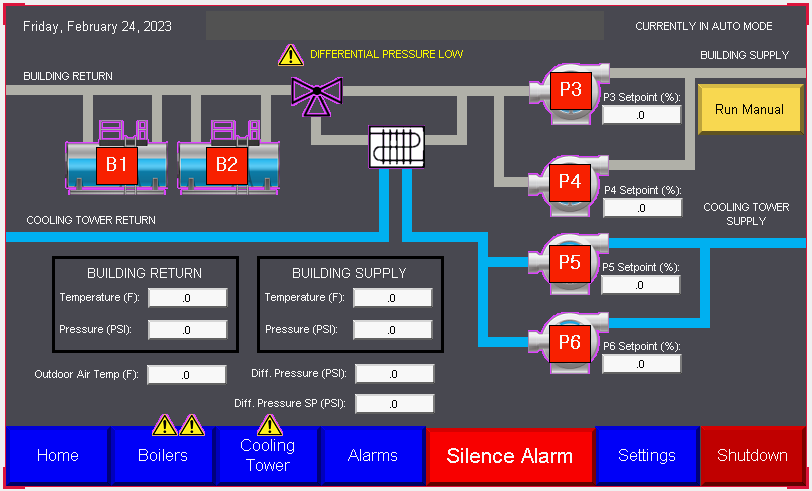
The PLC implemented switching between automatic and manual control modes. In automatic mode, PID control loops maintained differential pressure setpoints while seasonal logic managed cooling tower operation. In manual mode, operators specified fixed pump speeds and equipment states while the PLC continued monitoring safety interlocks and alarm conditions.
Operator Interface Design
The PV800 HMI provided multi-screen visualization:
Main Screen: Graphical system overview with color-coded status indicators and real-time process values
Equipment Screens: Dedicated views for the boiler and cooling tower systems showing operational state and equipment-specific parameters
Settings Screen: Password-protected access to setpoints, speed references, and control parameters enabling maintenance adjustments without PLC programming tools
Alarms Screen: Unified alarm management consolidating faults from all subsystems with consistent acknowledgment procedures
Technical Execution: Solving Real Integration Challenges
Challenge: Differing Process Response Times
Boilers respond slowly, as heat demand might take 30-60 minutes to stabilize temperatures. Pump VFDs respond instantly, with speed changes affecting pressure within seconds. The PLC needed to coordinate these dramatically different time scales, implementing longer verification timers for boiler runtime confirmation while using short timers for pump fault detection.
Challenge: Valve Position Verification
The heat exchanger used on-off valves with proximity sensors for position feedback. The PLC needed to verify valves reached their commanded positions within reasonable timeframes (20 seconds) and trigger alarms if they didn’t. This required comparing commanded state against discrete position feedback.
Challenge: Pressure Control Stability
Differential pressure control in a building with varying loads (different numbers of apartments calling for heating/cooling) required careful PID tuning. The PLC implemented a pressure control loop that adjusted pump speeds smoothly without oscillation.
Lessons for Multi-Vendor Integration Projects
1. Start with Clear Interface Definitions
Before equipment arrives on site, establish exactly what signals each vendor provides and requires. Document voltage levels, current ranges, contact ratings, and timing requirements. Ambiguity during procurement leads to expensive field modifications during commissioning.
2. Centralize Control Logic
Avoid distributed control architectures where vendors’ equipment makes siloed decisions where possible. Specialized equipment, like the boilers, have control over their own operations, but should not have control over other components of the overall system.
Centralized logic in the PLC provides predictable behavior, easier troubleshooting, and the ability to modify control sequences without coordinating changes across multiple vendors’ proprietary controllers.
3. Implement Comprehensive Alarm Management
Every fault condition from every vendor needs clear alarm messages, appropriate prioritization, and documented response procedures. The alarm system should guide operators to effective troubleshooting, not just announce that something is wrong.
4. Budget Time for Coordination
Multi-vendor projects require more project management time than single-vendor installations. Budget for meetings, information requests, interface clarifications, and commissioning delays.
Conclusion
This particular BMS project succeeded not just because of technical skills in PLC programming or HMI design, but because of effective coordination across stakeholders:
- Understanding vendor capabilities and limitations
- Translating operational requirements from facility management into technical specifications
- Managing project timelines
- Creating documentation that enables long-term operation without ongoing integrator support
Whether coordinating heating and cooling systems in a commercial building, integrating packaging lines in food production, or implementing process control in chemical manufacturing, the principles remain consistent: understand each system’s interfaces, implement centralized coordination logic, design for operator usability, and document thoroughly for maintainability.
Need help integrating multi-vendor equipment into cohesive control systems? Whether you’re coordinating HVAC systems, manufacturing equipment, or process controls, effective systems integration delivers operational efficiency, reduced maintenance burden, and unified visibility across diverse equipment.
Contact me to discuss bringing together your multi-vendor systems into integrated automation solutions that operators can manage confidently.
Note: I am not currently available for contract industrial automation work, but please reach out to me for details on how to move forward through the proper channels.