
Every industrial test bay, quality lab, or process cell has at least one instrument that doesn’t speak the same language as the rest of the control system. Power analyzers, temperature controllers, flow meters, and specialized test equipment often arrive with an RS-232 port and a communication specification document and not much else. Getting that data into a SCADA display typically means one of two things: buy a dedicated serial-to-[insert protocol here] gateway, or find another way.
This post describes one other way: a lightweight Python middleware application that runs directly on an IPC or PC already present in the vicinity of the RS-232 instrumentation, communicates with it using their native protocol, and writes data into Studio 5000 controller tags over EtherNet/IP. No gateway hardware. No proprietary configuration software. No vendor support tickets.
The result is full instrument data in the SCADA system for the cost of engineering time which, with modern AI-assisted development tools and a well-documented serial specification, can be measured in hours rather than days.
The Traditional Approach
When a project specification calls for integrating an RS-232 instrument into a Rockwell Automation SCADA system, the reflexive solution is a serial-to-Ethernet gateway (for Siemens, serial-to-Profibus). These devices sit between the instrument and the network, translate the instrument’s serial protocol into something the PLC can consume over EtherNet/IP, and present the data as controller tags.
On paper this is clean. In practice, the costs add up:
- Hardware Cost: $1,500 – $3,000 per gateway, depending on the manufacturer and protocol support.
- Configuration Tooling: Most gateways require configuration software, which has its own learning curve.
- Engineering Time: Vendor documentation, gateway firmware updates, protocol debugging through a proprietary interface, and back-and-forth with vendor support can stretch a simple integration from a few hours to multiple days.
Now, there are advantages to the traditional approach, depending on the details of your project:
- Flexibility: Gateways are meant to have flexibility built in (assuming you buy the correct model) for serial protocols. Start byte, checksums, etc. are click and draggable widgets in today’s modern applications (like the Anybus HMS-ES2SE-R).
- Scalability: If the serial protocol is Modbus RTU, gateways exist that can handle upwards to 31 devices. With the approach we will be talking about soon, scalability is more difficult.
As always, your application and specific circumstance determine the best course of action. Mainly #2 is the killer here: Scalability is best handled with an appropriate gateway. That said, if the application is a one-off where the device natively lives close to the PC or IPC, then the following may apply.
The Alternative: IPC-Based Middleware
Modern industrial PCs (IPCs) are already specified into SCADA panels for running FactoryTalk View SE client software. These machines typically run Windows, are equipped with multiple USB ports, and have significant compute headroom. A lightweight Python application running as a Windows background service consumes negligible resources while handling all serial instrument communications in the foreground.
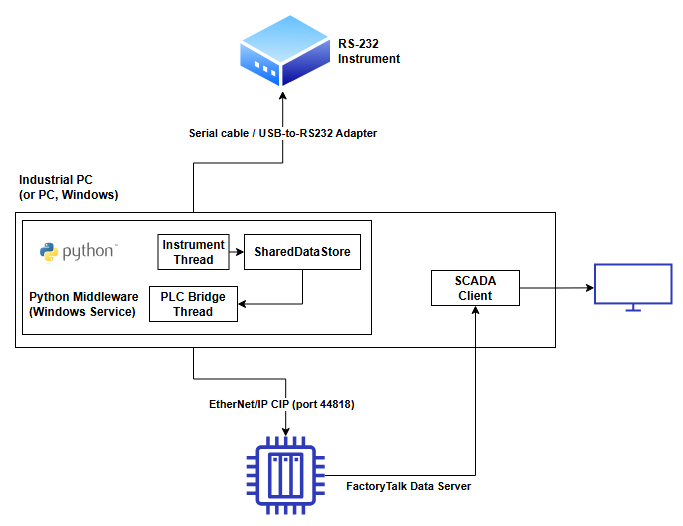
The architecture has three fundamental components:
- Instrument Thread: A dedicated background thread opens the RS-232 serial port, sends SCPI or custom protocol commands at a configurable scan rate, parses responses, and stores values in a central data store.
- PLC Bridge Thread: A second thread reads the data store and writes changes values into Studio 5000 controller tags via EtherNet/IP CIP (the same protocol Studio 5000 uses natively). No OPC server and no gateway.
- Shared Data Store: A thread-safe in-memory store decouples the instrument thread from the PLC bridge thread. Each runs at its own scan; neither blocks the other.
From the PLC’s perspective, the instrument data simply appears as controller tags. The SCADA system can read those tags through the normal FactoryTalk data server. Nothing in the integration chain is aware that the source is a Python application rather than a hardware gateway.
System Architecture
The following diagram describes the data flow from instrument to SCADA display:
Protocol Implementation
The central engineering task in this approach is implementing the instrument’s serial protocol in Python. For instruments that use SCPI (Standard Commands for Programmable Instruments) – a widely adopted ASCII-based command set – this is straightforward. For instruments with custom binary-framed protocols, it requires more care but is still well within reach using the manufacturer’s communication specification document.
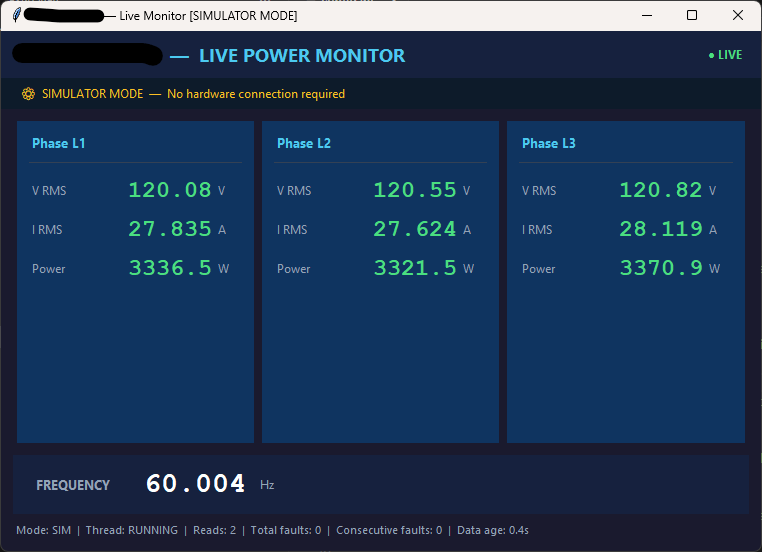
As a concrete personal example: integrating a harmonic power analyzer using an SCPI protocol over RS-232 at 9600 baud required implementing a poll sequence of 13 commands per scan cycle: one query to access the Frequency, three queries per phase (voltage, current, active power), and two more for status information. The full protocol driver, including connection management, fault recovery, and simulator mode for offline testing, was developed in a matter of hours using AI- and RAG-assisted development with the instrument’s communication specification as the primary reference.
The same approach applies to instruments with proprietary binary protocols, provided the manufacturer publishes a communication specification. Frame construction, checksum calculation, and response parsing are all implementable in Python from a written specification, which is the same information used to implement a hardware gateway solution.
With a well-documented serial specification and AI-assisted development, a working protocol driver — including fault recovery and simulator mode — can be completed in a few hours. The same integration via a proprietary gateway typically takes one or more days, spread across hardware procurement, configuration, and vendor coordination.
Fault Handling and SCADA Visibility
One underappreciated advantage of the middleware approach is the quality of diagnostics available to the SCADA operator. A hardware gateway typically exposes limited diagnostics information to the PLC.
A software implementation can expose as much diagnostic detail as the application demands. In this architecture, the PLC tag structure includes:
- CommsOK (BOOL): Set False when the serial link has been lost or the instrument is not responding.
- DataStale (BOOL): Set True when three or more consecutive poll cycles have failed – distinguishing a transient glitch from a sustained loss.
- Consecutive Fails (DINT): A rolling count of sequential failed poll cycles, giving maintenance personnel a direct indicator of link quality degradation before a full fault condition.
All of these values are standard Studio 5000 controller tags, addressable in ladder logic for alarm generation, and displayable on any FactoryTalk View SE faceplate. The SCADA operator or maintenance technician sees not just that the instrument is connected, but how well it is connected.
The middleware itself implements a graduated fault recovery sequence: brief retries on initial failure, reconnection attempts after three consecutive faults, and a 30-second backoff with automatic recovery after ten. This behavior mirrors what a well-written hardware gateway would do, but it is fully auditable and configurable by any controls engineer with access to the source code
Cost Comparison
| Cost Element | Dedicated Gateway Approach | IPC Middleware Approach |
|---|---|---|
| Hardware | $1,500 – $3,000 per gateway | $0 – runs on existing IPC |
| Software | Typically free configuration software with learning curve | Python + libraries |
| Protocol Development | Gateway maps fields; flexibility may be limited depending on the model | Full protocol implementation in Python, fully auditable and customizable |
| Lead Time | In stock up to multiple weeks depending on supply chain availability | Immediate. |
| Configuration Time | One or more days depending on vendor support and documentation quality | Minutes to a few hours with AI-assisted development from a well-documented serial spec and reasonable LLM prompting skills |
| Scalability | Potentially able to handle multiple serial devices, depending on the model | Handles one device per USB connection, limited to number of USB ports |
| Fault Visibility | Limited | Full per-tag logging, fault counters, stale data flags – all visible in SCADA |
| Long-term Maintainability | Tied to vendor firmware and support lifecycle | Open codebase; any controls engineer can modify it |
The hardware savings combined with lead time implications may be significant enough for you to consider a software solution.
The more durable advantage, however, is flexibility. A Python middleware application can be extended, modified, and adapted by any engineer familiar with the codebase. When an instrument firmware update changes a response format, or when a new measurement value needs to be added to the SCADA display, the change is a few lines of code rather than a vendor support ticket and a gateway firmware update.
When a Gateway Still Makes Sense
By now you should know that this approach is not universally superior. There are legitimate scenarios where a dedicated gateway is the right answer:
- No IPC in the panel: If there is no Windows-capable machine in the panel or within cable distance, the middleware has nowhere to run. A gateway bridges directly onto the network without a host computer.
- IT security policy restrictions: Most facilities prohibit application software from writing directly to PLC tags over EtherNet/IP from non-hardened machines. In those environments, an OPC-UA server or gateway may be required to satisfy the security architecture.
- Large Device Counts: If a fcility needs to integrate dozens of identical serial instruments, a purpose-built gateway applicance supporting multi-drop RS485 may be more practical than managing equivalent number of software threads.
- Certification Requirements: Safety-critical applications of highly regulated environments may require certified gateway hardware. A Python application, however well-engineered, does not carry hardware safety certifications.
For the majority of test bay, quality lab, and process integration applications, where an IPC or PC is already present, the instrument count is small, and flexibility is valued, the middleware approach offers a clear engineering and commercial advantage.
Conclusion
The assumption that serial instrument integration requires dedicated gateway hardware is worth examining on every project. Where an IPC or PC is already installed and the instrument manufacturer provides a communication specification, a Python middleware application running as a Windows service is a technically sound, cost-effective, and maintainable alternative.
The pattern described here (dedicated instrument threads, a shared data store, EtherNet/IP tag writes, and graduated fault recovery) has been validated against a live CompactLogix PLC. The full instrument integration, from serial communication to SCADA tag visibility, was built and debugged in a fraction of the time a gateway integration would have required.
If your next project includes an RS-232 instrument and an IPC already in the panel, ask the question before specifying the gateway: is there a smarter way to do this?